
Anyone who has managed a 360-degree assessment process knows this: the real work begins after the data is collected.
50 employees, each with an average of 5-6 raters. That's 250-300 forms. Every form contains open-ended questions -- a manager wrote three paragraphs, a peer brushed it off with "works well," and a direct report provided a very specific example.
HR needs to turn this pile into something meaningful. In the traditional process, that means Excel, Word, and exhaustion. And more often than not, the result is a generic summary along the lines of "there are areas for development."
This is exactly where AI makes a real difference.
In this article, I'll compare traditional 360-degree assessment with AI-powered 360 assessment -- both in methodology and in what actually changes in practice.
What Is 360-Degree Assessment?
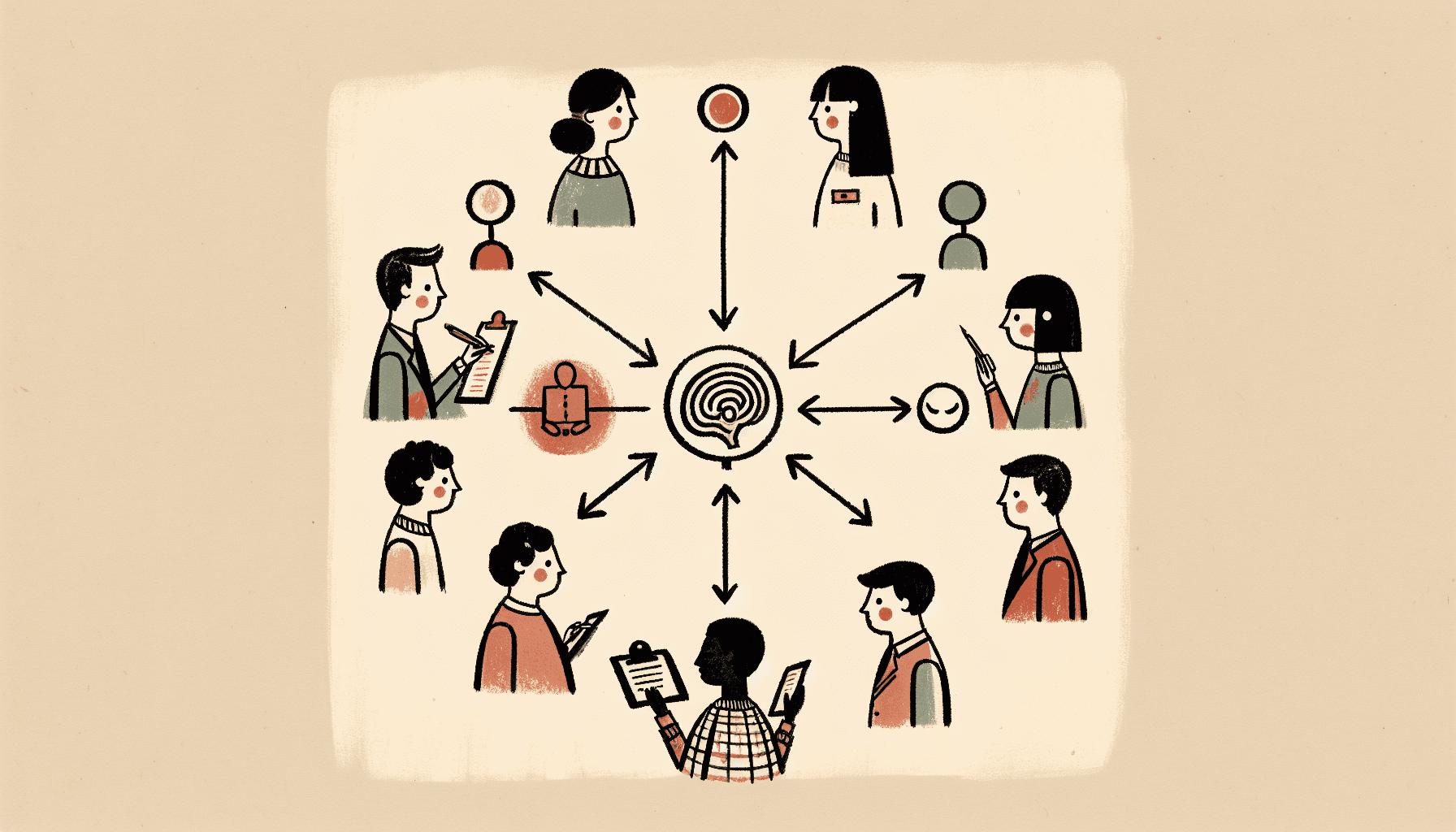
Before discussing AI-powered employee feedback systems, let's cover the basics: 360-degree assessment is a multi-source feedback process that evaluates an employee from every perspective -- manager, peers, direct reports, and the employee themselves.
The "360-degree" metaphor captures it perfectly: the employee becomes visible from every angle. Not just a top-down view -- but a picture drawn from everyone around them.
Where does this method prove its value? In revealing self-awareness gaps. Showing someone who says "I'm excellent at this competency" how those around them actually perceive it. Or the reverse: making visible those employees who rate themselves low but are highly regarded by their colleagues.
The Limitations of Traditional 360-Degree Assessment
The traditional process has four fundamental problems.
Problem 1: Inconsistent interpretations One rater says "excellent communication skills" while another says "can sometimes be hard to understand" -- and they're evaluating the same employee. Which one is right? Maybe both. Synthesizing these requires human judgment. And in that interpretation process, things easily become subjective.
Problem 2: Social desirability bias As raters, employees tend to either write overly positive feedback (to avoid upsetting people) or offer critical but unconstructive comments. Truly honest and helpful feedback requires both a safe environment and proper guidance. Without these, data quality stays low.
Problem 3: Time and operational burden Between collecting, tracking, sending reminders, and checking forms for each rater, the HR team can end up with weeks of work.
Problem 4: Failure to drive action This is the biggest problem. A nice report gets prepared, a development meeting is held, and then nothing changes for six months. If feedback isn't tied to concrete actions, it loses its value.
What Does AI Change in 360-Degree Assessment?
AI addresses each of these four problems at different levels.
For inconsistent interpretations: AI can analyze open-ended feedback and identify recurring themes. For example, if the word "communication" appears 12 times, it can determine that 8 mentions are in a positive context and 4 are flagged as development notes. Extracting this signal manually is exhausting; for AI, it takes seconds.
For social desirability bias: Through language analysis, AI can detect overly positive or meaninglessly generic comments and guide raters toward more specific feedback. Rather than "very good," it can more meaningfully interpret data like "specifically in situation X, they did Y and the result was Z."
For operational burden: AI is far more efficient at automating form collection tracking, automatic reminders, data consolidation, and report generation. This frees up HR to spend more time on analytical work.
For driving action: AI can be highly effective at generating personalized development recommendations. For example, "this employee's strengths are X, their development priority is Y, and recommended resources are Z" -- automatically bridging the gap from raw data to actionable plans.
Traditional vs. AI-Powered: Comparison Table
Dimension | Traditional | AI-Powered |
|---|---|---|
Data collection | Manual forms, email follow-up | Automated platform, smart reminders |
Qualitative analysis | Manual by HR/management | AI theme analysis + human review |
Report generation | Hours to days | Minutes |
Personalization | Limited | High |
Development recommendations | Generic | Role-specific, person-specific |
Bias detection | Weak | Language-level detection possible |
Cost | High (labor hours) | Medium (platform license) |
Data privacy risk | Low (stays in-house) | Medium to High (depends on platform) |
AI 360-Degree Assessment Tools: What Should You Choose?
There are two types of tools on the market:
Standalone 360 platforms: Assessment process + ongoing performance management + AI analysis all in one. These platforms are suited for enterprise scale with strong integration capabilities.
Traditional tools with an AI analysis layer: Solutions that take your existing forms or assessments and add an AI analysis layer on top. Lower cost, less setup required.
Additional questions for international deployments:
Can the platform analyze feedback in your organization's language(s)?
How is anonymity managed? (In small teams of 5 people, anonymous feedback may not truly be anonymous)
Is there a data processing agreement (DPA) compliant with your local data privacy regulations (e.g., GDPR, KVKK)?
Key Considerations for Anonymous Assessment Platforms
The promise of "anonymity" carries both advantages and risks.
Advantage: Raters write more honestly -- social desirability bias decreases.
Risk 1: Anonymity breaks down in small teams. In a team of 4 where there are 3 raters, the person being evaluated can usually figure out who said what. This affects both trust and data quality.
Risk 2: Anonymous negative feedback can turn toxic. Without identity, accountability disappears. Instead of constructive criticism, personal attacks can emerge. Platform design must carefully structure question formats and guidance to prevent this.
Risk 3: The "anonymous" category can be legally ambiguous under data privacy laws. If the system records who submitted the feedback -- even if it's not disclosed -- this may constitute personal data processing under regulations like GDPR or KVKK (Turkey's data privacy law, similar to GDPR). Technical anonymity and legal anonymity raise different questions.
AI 360 in Practice: Step by Step
Here's a brief overview of how to set up the system:
Preparation (2 weeks): Platform selection and setup. Defining rater relationships (who evaluates whom). Creating question sets and designing a balanced mix of open-ended questions. Preparing employees for the process.
Collection period (2-4 weeks): Form distribution, automatic reminders, completion tracking (AI tools automate this part almost entirely).
Analysis and reporting (2-3 days, compared to 2-3 weeks in traditional processes): AI theme analysis, score consolidation, individual report generation, team summaries. The HR team reviews AI output and edits as needed.
Development meetings (2-4 weeks): Each employee meets with their manager. Outcome: an individual development plan.
Follow-up (ongoing): A brief assessment after 6 months -- has there been progress in the identified development areas?
Final Thoughts
It's possible to transform the 360-degree assessment process from "a major annual operation" into "part of an ongoing development culture." AI tools make this easier by both collecting and analyzing data and turning results into meaningful action.
But let's also say this: if people don't genuinely want to give and receive honest feedback, no platform and no report will make a difference. Building that culture is still the hardest part, and no software can solve it on its own :)
Sources: CIPD 360 Degree Feedback Guide 2024, SHRM Performance Management Survey 2024, Harvard Business Review "The Problem with 360 Degree Feedback" (2023), KVKK (Turkey's Personal Data Protection Law).