
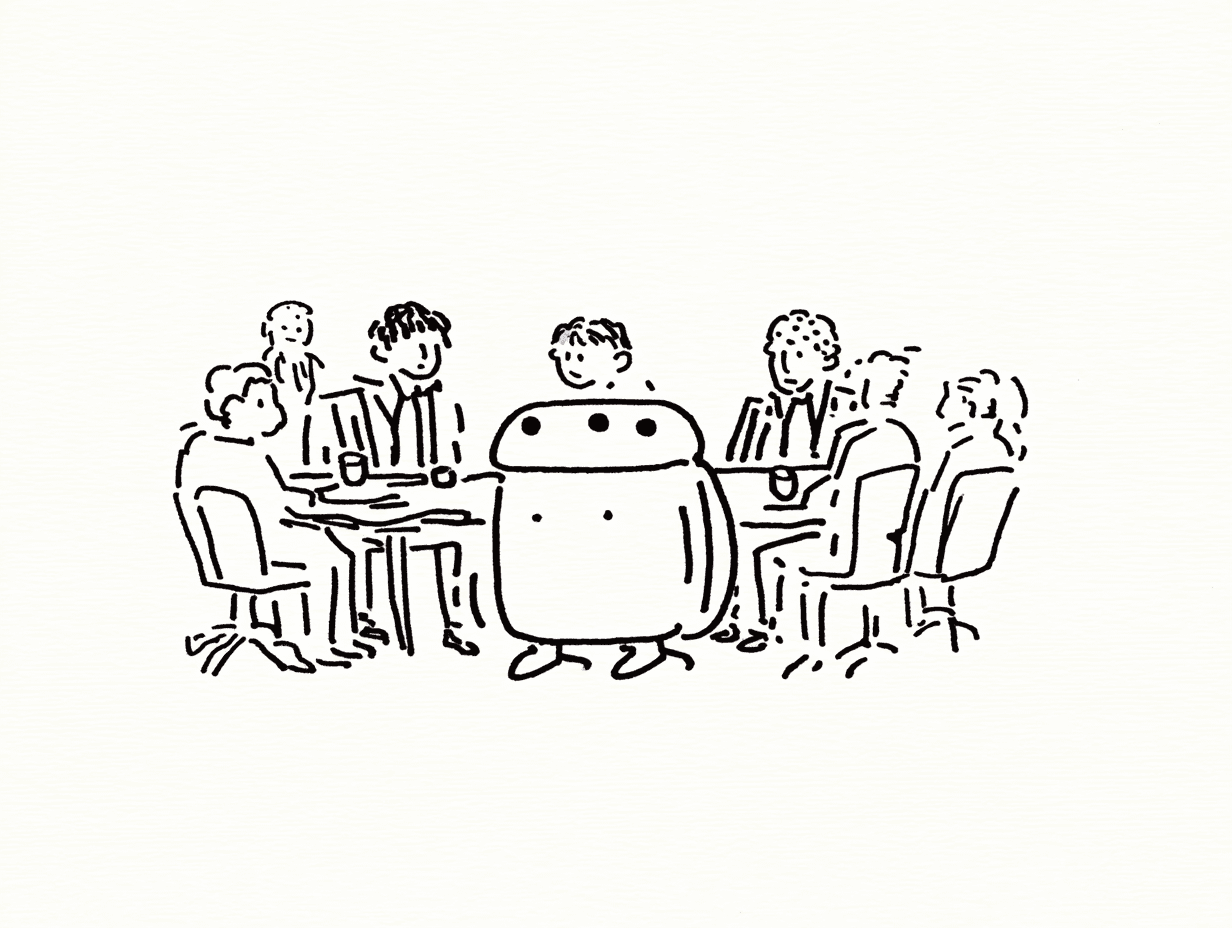
The hiring world is evolving beyond its traditional boundaries through the integration of artificial intelligence, transforming into a far more complex ecosystem. This shift doesn't just affect the relationship between job seekers and employers—it introduces a powerful and decisive third party into the process: hiring platforms. Recruitment decisions are no longer shaped solely by interactions between two people; they are now molded by the sophisticated algorithms these platforms develop and market. These new stakeholders are taking the stage as hidden architects who determine labor market outcomes.
The three-way stakeholder structure in the hiring ecosystem
With the rise of AI, a new stakeholder group—hiring platforms—has joined employers and candidates in the recruitment process. These technology providers are becoming the gold standard of the global market through the solutions they develop, increasingly steering the direction of the industry.
Marchetti and Scardovi's (2024) study highlights how AI solutions' ability to analyze thousands of resumes in seconds and predict a candidate's probability of success has made hiring entirely data-driven. Marchetti et al. (2024), analyzing interview processes at companies like Sace and Vodafone, note that these platforms don't just schedule interviews—they produce competency data claimed to be "objective," derived from candidates' tone of voice and facial expressions.
As outlined in the University of Sussex (2025) guide, it is vital for employer brand credibility that organizations deeply understand how the platforms they use embed their own hiring criteria into the algorithm. Diyin, Bhaumik, and Wang's (2024) research states that while these platforms attract employers with the promise of significantly reducing operational costs, careful attention must be paid to the ethical use of these systems.
The transparency gap and the need for a "Glass Box"
University of Sussex (2025) data documents that candidates have a very weak understanding of how the technology evaluates them, leading them to perceive the process as "dehumanizing." Jaser et al. (2025) argue that the key to bridging this digital divide is adopting a "glass box" approach—one that is fully transparent about how the technology is used. With a glass box approach, candidates can deliver their best performance knowing what is being scored, while employers gain fair access to a broader, more diverse talent pool.
Savani and colleagues (2022) note that candidates hold a belief that algorithms cannot recognize their "uniqueness," which triggers algorithmic resistance. The University of Sussex (2025) toolkit study emphasizes that rather than simply promoting the benefits of the technology, platforms have an ethical obligation to clearly disclose to candidates what the AI measures on behalf of the employer. GFI Group Limited's (2025/26) report states that platforms and employers that adopt a transparent communication strategy gain a significant advantage in the war for talent.
Conclusion: Merging human touch with technological power
Research shows that even when candidates experience the speed of AI at the start of an interview, seeing a human face at the end serves as "proof that they are valued." Jaser (2025) notes that developing ethical algorithms that also safeguard candidate interests is no longer optional for platforms—it is a necessity for a sustainable business model.
In this new multi-stakeholder hiring landscape, success belongs to those who can harmonize the speed of algorithms with human empathy and ethical oversight.
References
Diyin, Z., Bhaumik, A., & Wang, D. (2024). Artificial Intelligence's Impact on Hr and Talent Acquisition. Journal of Electrical Systems, 20-11s, 4879-4885.
Drela, K., Grabowska, A., & Brojak-Trzaskowska, M. (2025). The Future of AI in HRM. A Case Study of the HR Decision-Making. 28th European Conference on Artificial Intelligence (ECAI 2025).
GFI Group Limited. The Ethical Use of AI and Automation in Recruitment (2025/26).
Jaser, Z., Petrakaki, D., Starr, R., Oyarbide, E., Williams, J., & Newton, B. (2025). Artificial Intelligence (AI) in the job interview process: Toolkit for employers, careers advisers and hiring platforms. University of Sussex & Institute for Employment Studies.
Jurado, N. (2025). The effects of artificial intelligence on shaping employer brand perception: insights from entry-level hiring practices. Master Thesis, Universidad Carlos III de Madrid.
Marchetti, D., & Scardovi, R. (2024). Artificial Intelligence and Human Resources: innovative trends and main impacts. Master Thesis, Politecnico di Milano.
Savani, K., Lavanchy, M., Reichert, P., & Narayanan, J. (2022). Applicants' Fairness Perceptions of Algorithm-driven Hiring Procedures. IMD & NUS Business School.
Tuffaha, M. (2025). Adoption Factors of Artificial intelligence in Human Resource Management. Universitat Politècnica de València.
Venkanna, G., Yogesh, D. M., Rao, J. Y., & Preetham, K. S. (2024). Smart Applicant Tracking Systems in the Future. International Journal of Computer Science and Network Security.