

Last year, I was meeting with the digital transformation director of a bank. The company had been making major investments for years — AI tools purchased, infrastructure built, software licenses active. Everything was ready.
"But are employees actually using it?" I asked.
A brief silence. Then: "They have to. But... are they really using it? I don't know."
This is the least discussed truth about enterprise AI transformation: buying the technology is easy. Getting employees to adopt it — learning it, trusting it, integrating it into their daily work — is an entirely different process.
And without that process, millions of dollars in AI investment sits on the shelf.
In this article, we'll walk through the 6 essential steps to building an employee training program for enterprise AI transformation. Including real-world examples, measurable metrics, and common mistakes.
The Role of Employee Training in Enterprise AI Transformation
According to industry research, the biggest barriers to AI transformation within companies rank as talent gaps (58%), budget constraints (57%), and organizational culture issues (55%). In other words, it's the people — not the technology — who aren't ready.
This resistance is understandable. Employees have two fears about AI: they'll lose their jobs, or they'll be forced to learn something incredibly difficult. Both fears are fueled by misdirection and lack of communication.
This is where a training program comes in — but not just "What is AI?" slide decks. A well-designed training program does three things:
First, it transforms fear into concrete competency. Instead of "I'm afraid of AI," the mindset shifts to "I can use this tool for this task in this way." Second, it creates a shared language across the organization — everyone starts speaking the same concepts. Third, it improves real business outputs: faster communications, better reports, less repetitive work.
But achieving this requires building the program correctly. Most companies stumble here.
AI Training Program Design: A 6-Step Process
How do you deliver AI training across a company? The short answer: needs analysis, level assessment, curriculum, implementation, measurement, iteration. Let me break down each step.
Step 1: AI Competency Level Assessment
Not everyone starts from the same point. Some employees have been using ChatGPT for months; others have never even opened it. Some intuitively know how to write prompts; others stare at the screen thinking, "What do I even type?"
Giving the same training to different starting points bores the advanced learners and loses those who are behind. That's why the first step is level assessment — measuring each employee's current AI competency.
For those asking what AI literacy means: it's not just "knowing what AI is" — it means being able to use AI tools in a real work context. Asking the right questions, evaluating outputs, spotting errors, knowing security boundaries.
Surveys alone aren't enough to measure this level. Everyone says "yes" to "Do you use AI?" these days — but how they use it varies wildly. Real assessment requires task-based evaluation: give employees a realistic scenario, have them complete it, and evaluate the output.
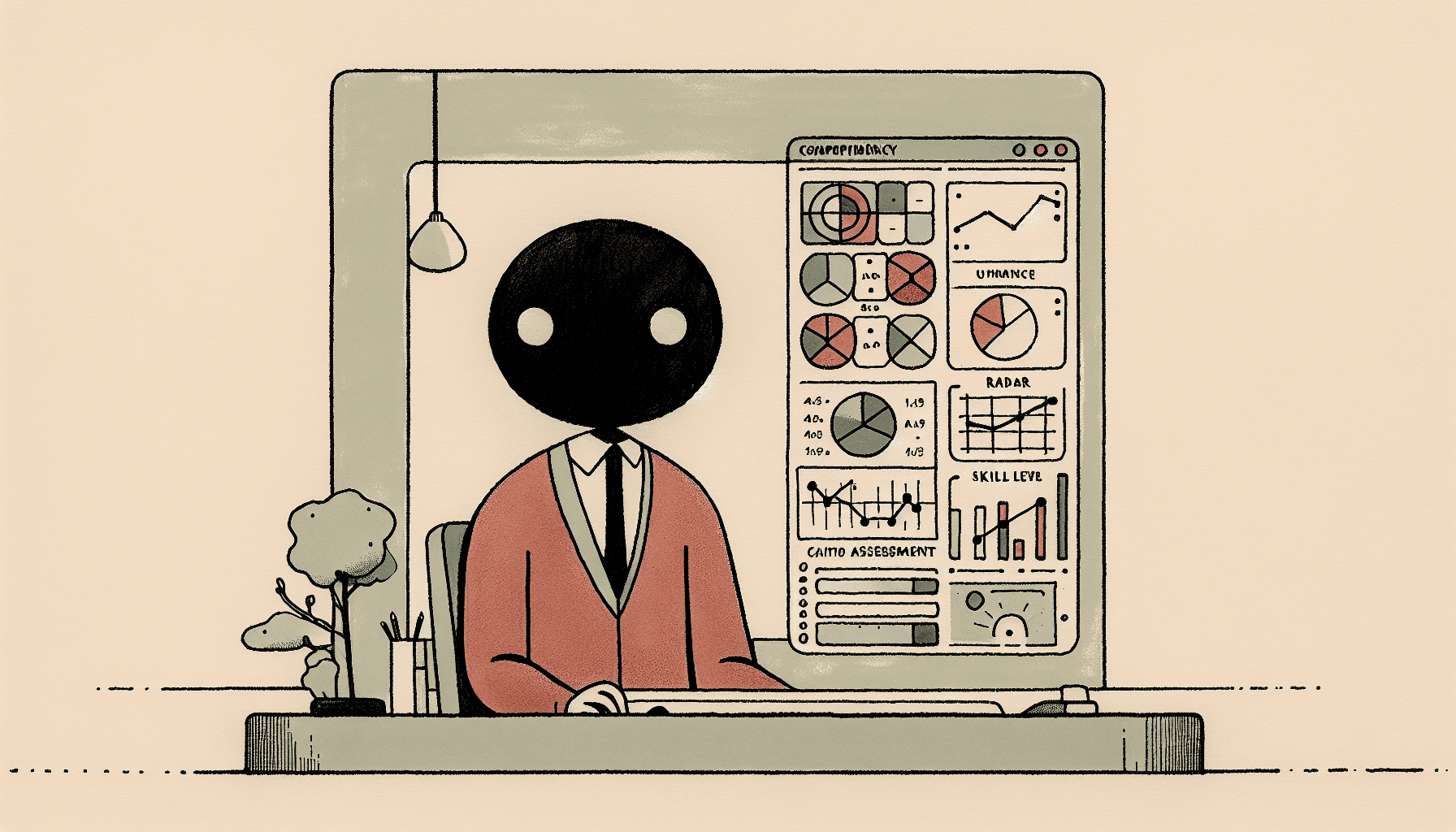
jobnest.ai's AI competency assessment platform was designed for exactly this — an adaptive test with hundreds of tasks, producing scores across eight dimensions and customized by department. The result is a profile for each employee, and an aggregate team view for managers.
With this data, you group your team: beginner, intermediate, advanced. From there, each group gets a separate curriculum.
Step 2: Role-Based Curriculum Design
"Let's give the whole company the same AI training" — this is the most common mistake. An accounting manager's AI needs are very different from those of a sales representative or a software developer.
Think of the curriculum in two layers:
Foundation layer — AI literacy for everyone: This layer is universal. What AI is, how it works, which tools are available, what hallucinations are and why they matter, what to watch out for when sharing data. Everyone should receive this foundation — from the CEO to the intern.
Depth layer — Role-specific application: This layer branches by role. For HR: resume analysis, job description writing, interview question generation. For sales: proposal preparation, customer communication optimization, market research automation. For finance: report summarization, data analysis assistance, anomaly detection. For marketing: content creation, brief writing, A/B test hypothesis generation.
Making this distinction seems like it increases content production — but the opposite happens. When employees feel "this training is relevant to my work," completion rates rise dramatically. While generic AI training completion rates hover around 20-30%, role-based programs reach 70-80%.
Step 3: Microlearning and Blended Learning
The "3-day AI training camp" model doesn't work. You absorb intense information for three days, return to work on day four, and forget 80% of it within two weeks. That's how the brain works.
The model that works: short, repeating, application-tied learning.
Microlearning: 5-15 minute modules focused on a single skill. A specific question like "In this module, how do you give Claude good context?" moves to application much faster than a theoretical "What is an LLM?" lecture.
Scenario-based learning: "What would you do in this scenario?" questions. These trigger thinking in real work contexts. For example: "A customer sent a complaint email. How would you respond using AI? What information do you include, and what do you leave out?"
On-the-job application: Weekly "AI experiment" assignments. Each week, employees are asked to try one thing in their work using AI and share the results with the team. This reinforces learning and builds a "what did we discover?" culture within the team.
Measuring Training Effectiveness: KPIs and ROI
"We did the training, it went well" — that's not enough. If you want to see the return on your investment, you need to measure. But what do you measure?
Start with the Kirkpatrick Model:
Level 1 — Reaction: Were employees satisfied with the training? Surveys, NPS. Important but surface-level.
Level 2 — Learning: Did they actually learn something? Pre-test / post-test comparison. Competency score changes.
Level 3 — Behavior: Are they applying it at work? AI tool usage frequency, which tasks they use it for, manager observation.
Level 4 — Results: Did it reflect in business outcomes? Task completion time, error rates, quality of produced content.
AI-specific additional metrics:
Prompt quality score (before/after training comparison)
AI output acceptance rate (how much AI output employees use without editing vs. rewriting from scratch)
New tool adoption speed (how quickly they start using a new AI tool when introduced)
AI-assisted task completion rate (how many tasks per week they supported with AI)
Tracking these metrics takes time, but making decisions without them is far more expensive. You can't answer "Did the training work?" without data.
5 Common Mistakes and Their Solutions
Many enterprise AI training programs stumble at similar points. Knowing these in advance saves significant time and money.
Mistake 1: One-time "campaign training"
"We delivered AI training this quarter, we're done." AI tools change every three months. Most of what's learned becomes outdated within six months or is forgotten if not reinforced.
Solution: Build a platform, not a program. Continuously updated micro-content, monthly "what's new" modules, internal community.
Mistake 2: Not including senior leadership
When employees see their managers not using AI, the message is clear: "This must not be important." Leadership participation serves as both model behavior and a cultural signal.
Solution: Start with a short, dedicated "AI leadership" program for senior management. Once managers gain foundational competency, guiding their teams becomes much easier.
Mistake 3: Buying off-the-shelf content
"We bought this platform's AI course, everyone should complete it." Generic courses produce generic results. If employees think "What does this have to do with my job?" they won't retain anything from the training.
Solution: Use off-the-shelf content as a foundation, then enrich it with organization-specific case studies. Add scenarios involving your own customers and your own processes.
Mistake 4: Skipping data privacy and security
You're telling employees to "use AI" but not explaining which data they can use and where. An employee uploads a file containing customer data to a public AI tool. Both a legal risk and a trust issue.
Solution: Every AI training program should include a mandatory "dos and don'ts" module. Data classification under applicable privacy regulations (such as GDPR, or KVKK in Turkey), which tools have corporate approval, security protocols — these are inseparable parts of the training.
Mistake 5: Ignoring resistance
"They have to learn anyway; if they resist, that's their problem." This approach is both wrong and expensive. Behind the resistance are real fears and real questions: Will I lose my job? What happens if I make a mistake? Can I trust these tools?
Solution: Have this conversation openly at the start of the training. The saying "AI won't take your job, but someone using AI might" may sound cliched, but it's true — and sharing it honestly with employees makes change management much easier. Create a safe space: make it concrete that making mistakes is part of learning.
Final Thoughts
If you're considering building an upskilling or reskilling program at your company, or want to review your existing program, I'd recommend measuring your team's AI proficiency first. It's hard to plan where you're going without knowing where you're starting.
Sources: Turkey AI Initiative (TRAI) - Artificial Intelligence Research.