
Last month I was talking to the HR director of a large conglomerate. They have 1,200 employees. Their digital transformation budget was ready, board approval had come through, and training platforms had been selected. Everything appeared set for launch.
Except for one thing: they didn't know who needed what.
She told me everyone "wanted to learn AI." "But which AI, at what level, for which role — we couldn't figure that out."
This admission isn't unique to that company. In many organizations, training budgets are spent without knowing which skills each employee actually needs. Then comes the familiar refrain: "we're not getting ROI from training."
This is precisely where employee skills analysis comes in.
In this article, we want to offer you a practical guide. We'll place traditional methods side by side with AI-powered approaches, lay out the pros and cons, and wrap up with actionable steps.
What Is Employee Skills Analysis and Why Does It Matter?
Employee skills analysis is an HR process that systematically measures the existing competencies within an organization to identify development needs.
That's a straightforward definition. But the cost behind it is anything but straightforward.
In an environment where both labor costs and digital transformation pressure are rising simultaneously, poor training decisions don't just mean financial loss — they mean critical time lost as well.
Numbers aside, the real problem is this: most companies only realize what happens when skills analysis isn't done after the fact. Training programs are completed, certificates are handed out, LMS dashboards are covered in green checkmarks — but nothing changes in actual job performance.
Pre-Analysis Preparation: 3 Critical Steps
Before jumping into the analysis, you need to clarify three things. If you skip these steps — and I say this from experience — the data you collect down the line will tell you nothing.
1. Define your competency framework.
You can't measure what you haven't defined. Will you use an industry-specific competency model? CIPD's universal framework? Or will you build one tailored to your own roles? This decision shapes every subsequent step.
There's an important trap here: starting with "let's measure everything." When you try to measure 40 different competencies, you both overwhelm the process and make the results impossible to untangle.
2. Bring stakeholders to the table.
HR doing this alone can undermine organizational ownership. Department heads, team leads, and even high-performing individual contributors should be part of the process. Don't fall into the "we'll move faster without them" trap.
There's a very simple reason for this: the people who will own the results are the managers. If they haven't been included in the process, they can take the reports and set them aside with "we weren't consulted." Spending 2 extra hours upfront to save 2 months later is a much better calculation.
3. Write your success criteria in advance.
When the skills analysis is complete, what will you have in hand? What decisions will you be able to make? Which questions will you have answered?
If you don't answer these questions upfront, here's what happens: a beautiful report is ready, the data is there, the presentation is delivered — but the question "okay, so what do we do with this?" hangs in the air. The analysis never translates into action, and the process quietly retires.
5 Core Skills Analysis Methods
Now let's get to the heart of the matter. Let's look at the tools you have at your disposal and how each one actually performs in the real world.
1. Competency-Based Interview (STAR Technique)
Situation, Task, Action, Result — the STAR technique attempts to predict future performance from past behavior. The logic is simple: "How did you handle this situation in the past?" reveals far more than "How would you handle this situation?"
Pro: Captures human nuance. The context is rich, the narrative is valuable. You can understand not just what an employee did, but how they thought and what they learned.
Con: Time-consuming, expensive, and doesn't scale. Conducting STAR interviews for 500 employees is extremely challenging. It's also highly susceptible to evaluator bias: two different interviewers can score the same answer very differently. Without interviewer training, personal sympathies come into play and data quality degrades.
When to use: For in-depth assessment of managerial positions and critical roles. This method isn't sufficient for large-scale competency analysis.
2. 360-Degree Assessment
You evaluate the employee from every angle: manager, peers, direct reports, and the person's own self-assessment. What emerges is a profile showing both how others see them and how they see themselves.
Pro: Its ability to reveal the self-awareness gap is incredibly valuable. "I give myself a 9, others give me a 5" — that gap sits at the very center of the development conversation. It's not just a performance measurement; it's also holding up a mirror.
Con: It doesn't work in companies that lack a feedback culture. People either write overly positive reviews (to avoid upsetting a colleague) or hide behind anonymity to deliver unfair criticism. When poorly implemented, it both damages trust and produces worthless data. This method is also difficult to scale — multiple people need to dedicate time for each employee.
When to use: In leadership development and high-potential programs. Applying it to the entire organization is less efficient than focusing on specific groups.
3. Competency Inventories / Psychometric Tests
Standard questions, normative comparisons, scientifically grounded measurement tools. Personality types, cognitive competencies, emotional intelligence — these tools position employees within a predetermined framework.
Pro: They offer reliable and comparable data. The risk of subjective interpretation varying from person to person is low. They can be administered at large scale.
Con: Expensive licenses — quality psychometric tools require significant investment. And more importantly: what they measure doesn't always align with actual job performance. Someone can produce excellent test results but turn out to be mediocre on the job. Or the reverse — mediocre test results but an outstanding team member in practice.
Understanding this method's limitation is important: it provides data about potential and tendencies, not about current competency level.
When to use: As supplementary data in pre-hire screening or high-volume role assessments.
4. Assessment Center
Role plays, simulations, group exercises, case studies. You observe the employee under conditions that closely mirror reality — not "what would you do?" but "let's do it."
Pro: The highest validity rate belongs to this method. It's the approach that best reflects actual workplace behavior. Observing a managerial candidate in a real crisis scenario tells you far more than asking them dozens of questions.
Con: This is also the heaviest method in terms of organization and cost. Large companies can run it once a year; smaller organizations may never run it at all. Evaluator training is critical — with poorly trained observers, calibration breaks down. It's a full-day process, sometimes spanning several days.
When to use: For senior executive selection and critical promotion decisions. Not for the entire organization — for strategic positions.
5. AI-Powered Competency Testing
This works fundamentally differently from traditional methods. You enter the system and are assessed through evaluations specifically assigned to you. AI analyzes the output and delivers a personalized report with a development plan.
The result is a dimension-based profile — not just "pass/fail" but a map showing where you stand on each dimension.
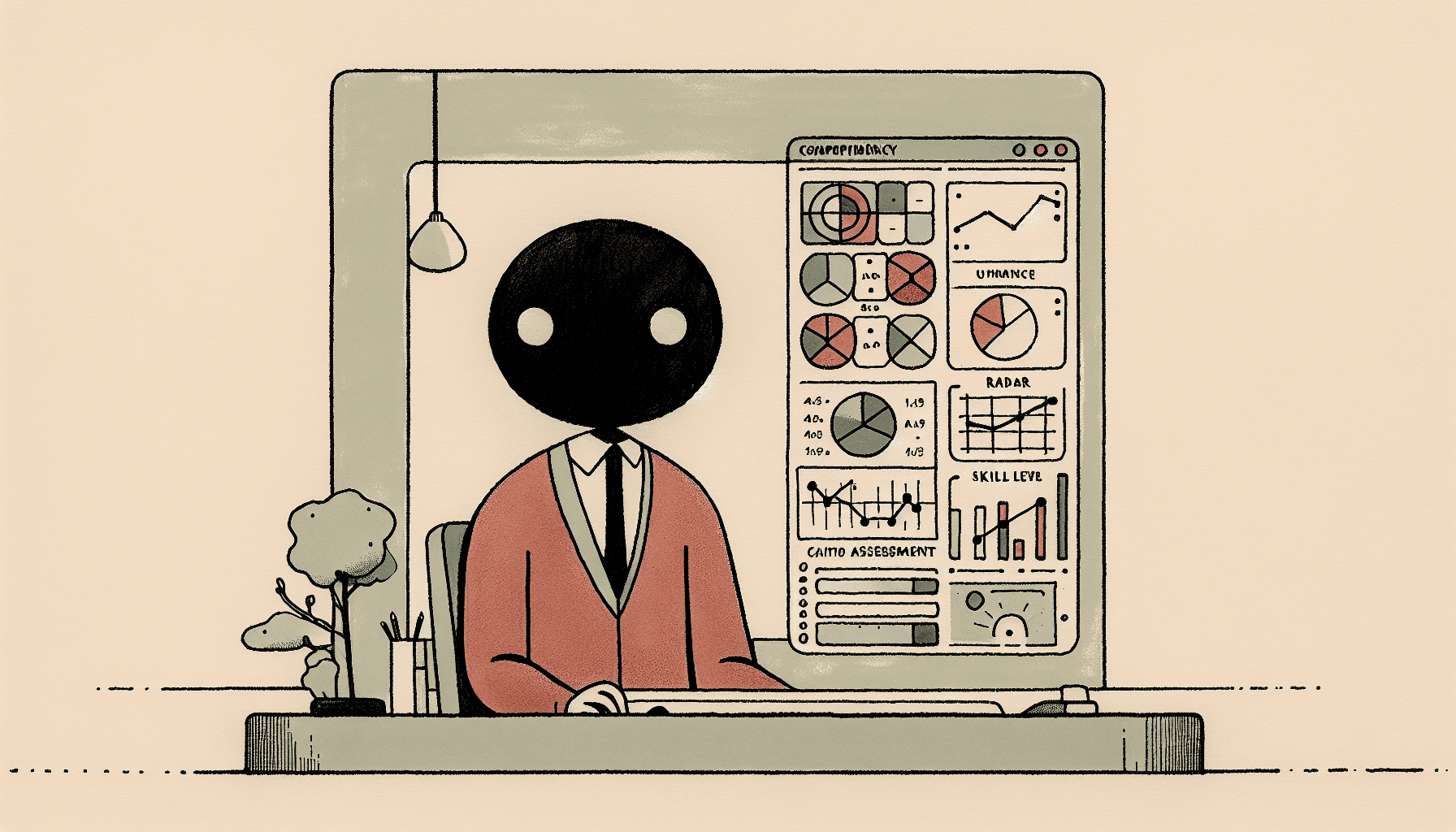
For example, jobnest.ai's AI competency assessment evaluates employees across eight dimensions and can be customized for each department. It includes not just multiple-choice questions but also hands-on assessments like prompt writing exercises.
Pro: Scalable. Fast. Objective. Requires no one-on-one interviews, eliminates evaluator bias. Measures actual work output — answers the question "can you do this?" rather than "do you know about this?" Cost is dramatically lower compared to traditional methods.
Con: Still an evolving methodology — ready-made test libraries adapted for every industry role aren't fully mature yet. Calibration work is needed for non-technical roles. And it doesn't fully capture human nuance: in dimensions like motivation, context, and leadership potential, traditional methods still hold value.
When to use: For AI competency measurement in mid-to-large-scale teams, rapid talent mapping, and pre-training needs analysis. More of a complement to traditional methods than a replacement.
Comparison Table
Method | Cost | Duration | Accuracy | Scalability |
|---|---|---|---|---|
STAR Interview | Medium-High | Long | Medium | Low |
360-Degree | Medium | Medium | Medium-High | Medium |
Psychometric Test | Medium | Short | Medium | High |
Assessment Center | Very High | Very Long | High | Very Low |
AI-Powered Test | Low | Short | High | Very High |
Competency Gap Analysis: Current vs. Required Skills
How do you create a competency map?
You've applied your methods, the data has come in. Now what?
Gap analysis answers exactly this question: What do I have, what should I have — how far is the distance?
To do this, you need two things:
1. Role-based competency profile: The answer to "what skills at what level are needed to do this job well?" for each role. You can build this profile from job descriptions, analysis of high-performing employees, and department manager input. Deriving the answer to "what does a successful data analyst look like?" from real data is far more reliable than relying on intuition.
2. Actual measurement data: Each employee's current status through one (or several) of the methods described above.
When you place these two side by side, the gaps become visible. For example: AI tool usage is a critical competency for your data analysts, but when you measure, you find that 60% of the team falls below the baseline level. This determines your training priority. Instead of "let's give everyone a general AI training," you can now say "this team needs a program focused on practical tool usage that skips past the basics."
You can use competency gap analysis templates to put this into practice.
Automating Skills Analysis with AI Tools
"Can employee competency testing be done with AI?" — yes, it can. And it's getting better all the time.
Let me share a transition experience from one of our enterprise clients who moved from traditional to AI-powered competency analysis. Previously, a full competency analysis process for a team of 50 took 6-8 weeks — survey design, interview scheduling, evaluator coordination, data compilation, reporting. And the data quality we ended up with was debatable because evaluator inconsistencies were rampant.
With the AI-powered process, assessment for the same 50 people dropped to 1 week. More importantly: reports were standardized, managers got comparable data, and individual development recommendations were generated automatically. The managers' question of "what do I do to analyze this?" disappeared — the system already provides the answer.
But the most critical aspect of this transition was this: the AI tool had to learn to ask better questions than the process it replaced. Simply saying "we handed it to AI" isn't enough — designing which outputs to measure, which dimensions to evaluate, and how to interpret the results is still a human job.
When choosing among AI competency assessment tools, seek answers to these questions:
Is the measurement truly task-based, or just knowledge questions? (The latter is far less valuable.)
Do results come in a format that HR can understand and act on?
Is there local language support and alignment with local business context? A tool that doesn't fit the local workforce dynamics can produce misleading results, however polished the graphs may look.
Is there compliance with data privacy regulations such as KVKK (Turkey's data privacy law, similar to GDPR)? Where employee data is processed is a legal question.
Turning Results into Action: Building a Development Plan
You've done the skills analysis. You've found the gaps. Now comes the most critical step: turning that data into concrete action.
Most companies get stuck here. A beautiful PowerPoint is prepared, presented to the board, "interesting results" is the verdict, and the file goes into the archive. That won't cut it.
For individual development plans:
Each employee's gap analysis data should serve as the foundation for a development conversation. The manager and employee should look at the same data and be able to say "in this area, let's reach this target within 6 months." The goal should be measurable, time-bound, and something the employee themselves takes ownership of.
There's an important nuance here: show the data to the person, but show it without judgment. Framing it as "you have growth potential in this dimension" rather than "you're weak in this area" opens a very different conversation. The same data, with different framing, can build both motivation and confidence.
For organizational training strategy:
When you aggregate individual plans, organizational patterns become visible. Maybe all your mid-level managers have a gap in leadership communication. Maybe your entire customer service team is at beginner level in AI tool usage. This collective data tells you where to direct the training budget.
And I'd like to add this: skills analysis is not a one-off project. It should be updated at least once a year — because the skills the business needs are changing. The critical competency of 2026 wasn't even on the radar in 2024. By combining 360-degree assessments and AI tools, you can build an ongoing competency monitoring mechanism — not a one-time snapshot, but a living picture.
Final Thoughts
HR's toughest question is always the same: "Where should we invest?"
Skills analysis is the way to answer that question based on data rather than guesswork. Traditional methods offer depth but can't scale. AI-powered methods offer speed and scale but require thoughtful design. Using both in the right combination is what separates the 2026 HR professional from their predecessors.
Let me circle back to that conversation with the conglomerate director. We spoke again a few months later. This time we had data — from all 1,200 people, department by department, dimension by dimension. "Now I know where we're headed," she said.
That was all it took to get started.